Platform overview
The hosted Membase at app.membase.com as your code meets it: the nouns, what each screen of the app is to the API, credentials, one account per person, limits, the Marketplace, and what can be undone.
The Memory Platform is the hosted Membase at https://app.membase.com. A person hands it
material once; it keeps a living memory of that material; every AI they connect, and every
key they mint, reads the same memory. The mechanism is on
How Membase works; this page is the product around it, written for
someone whose code will meet what the person sees. The screens themselves, one page each,
are in the Use Membase tab.
The nouns
Section titled “The nouns”| API | In the app | What it is |
|---|---|---|
Memory (memory_name in answers) |
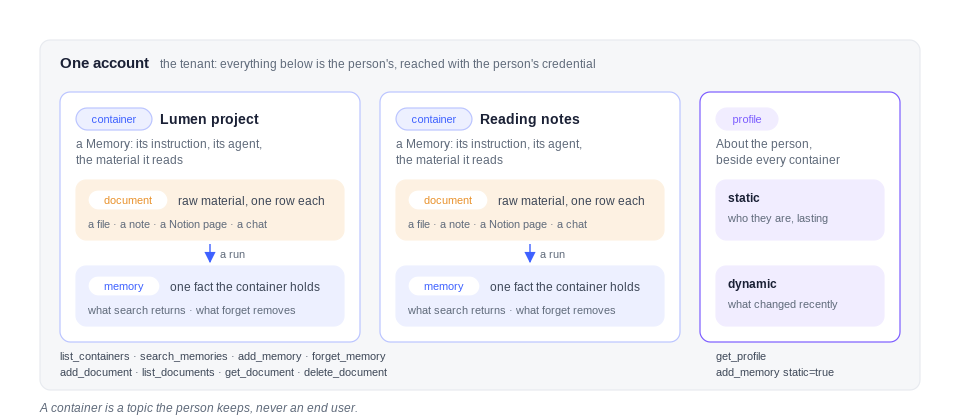
a Memory | one named space of memory, with the agent that keeps it and the material it reads. Named in answers, never addressed in a request |
memory (mem_…) |
an item on a Memory’s page | one fact a Memory learned |
document (doc_…) |
a row under a Memory’s sources | one piece of material handed in: a file or a page (kind: file), or a fact as it was said (kind: note) |
media (med_…) |
a photo or video in a media Memory | what was seen or said in it, with its moments |
Plain verbs: list, search, get, add, delete, forget, ask.
Memory operations walks them; the API reference
has every operation.
A profile sits beside the Memories: standing statements about the user (pf_…), each
with where it came from (source_kind). list_profile_facts reads it; add_profile_fact
and forget_profile_fact keep and forget one, on a key whose level allows it.
A credential reads every Memory it reaches; a write lands in the one text Memory it reaches,
and a credential that reaches several is refused with 422 write_target_required.
The screens
Section titled “The screens”| Screen | The person uses it to | Your code meets it as |
|---|---|---|
| Home | talk to the assistant, the one agent that is theirs by default; reach it on Telegram | the profile facts it records (source_kind: model_generated); the assistant’s own memory is not a Memory here |
| Memory | make, run and inspect Memories | search_memories, list_memories, get_memory, the facts forget_memory removes; a document’s learning turning succeeded after a run |
| Files | keep files, and hand folders, uploads, Notion pages and captured conversations to a Memory | add_document, list_documents, get_document, delete_document |
| Studio | edit a Memory’s pipeline canvas | nothing |
| Agents | build agents beyond the assistant | nothing; the memory API reaches Memories, not agents |
| Schedules | run Memories on a cadence | a document’s learning turning succeeded without a call of yours |
| Activity | see what ran | the run a 202 from add_document started; a key’s own calls are on the key’s page |
| AI Setup | choose the account’s model | 422 · capability_unavailable when there is none |
| Connect | let an AI app read Memories, mint keys | consent tokens and developer keys: Authentication & Scopes |
| Marketplace | sell and buy access to a Memory | a buyer’s credential, ask_memory |
| Settings | plan, export, delete | 422 · capability_unavailable with details.reason: "dormant" on a free plan whose turns are spent |
Credentials
Section titled “Credentials”Every call carries a bearer: a developer key the owner minted, or a consent token an app received on the OAuth consent screen. A key has a level (Read, Read & write, Full access), a reach (the Memories it may use) and an expiry; a consent token is read-only and reaches what the user ticked. Both are managed by the account owner in Connect. Authentication & Scopes has the whole model; the keys screen is under Connect in the user guide.
A key’s calls are on the key’s page, not on Activity: Usage (calls in the last 30 or 7
days, how many were refused, the tool it calls most) and Recent activity (each call:
tool, Memory, what came back, when; a refused call in red with the reason). The same numbers
are on GET /v1/keys/{id}/usage with the owner’s session.
One account per person
Section titled “One account per person”The account is the tenant. A Memory is a topic, not an end user. A product that serves many people gives each of them their own Membase account, and reads their memory with their own key or their own consent; there are no application-wide keys and no sub-tenant tags. Multi-user isolation has the patterns.
Models
Section titled “Models”Every learning turn, every search and every assistant answer needs a model. The account
chooses it under AI Setup: a key of its own for a provider, or a Claude or ChatGPT
subscription. Follow the connection and verification steps shown in AI Setup. An account with no working model keeps
its stored memory, but learning and hosted search need working agent turns. A search may
name the Memories that could not answer in partial; documents can remain unread.
How Membase works.
Limits and errors
Section titled “Limits and errors”Search and every list name the Memories that could not answer in partial on an HTTP
200. Check that field before treating an empty result as “nothing found.” API troubleshooting
covers partial failures, deferred learning and timeouts.
| Status | Code | When |
|---|---|---|
| 400 | validation |
an empty q, both or neither of content and url, a limit out of range |
| 401 | unauthenticated |
no bearer token on the request |
| 403 | unauthorized |
an invalid, expired or revoked key, or a verb above its level |
| 404 | not_found |
an id that is not this credential’s to read: outside its reach, deleted, or not one of ours |
| 422 | validation |
a missing, mistyped or unknown body field (container included); read code to tell it from the rows below |
| 422 | write_target_required |
a write from a credential that reaches several Memories |
| 428 | confirmation_required |
a delete or forget without confirm=true; nothing changed (a credential that holds no destructive verb gets 403 first) |
| 422 | capability_unavailable |
the account’s memory cannot run a turn here (no agent container, no model) |
| 422 | capability_unavailable |
with details.reason: "dormant": a free-plan account whose free turns are spent |
| 429 | rate_limited |
the account’s concurrent-turn budget, or the token’s per-minute request limit; retry later |
Uploads through add_document are capped at 32 MiB per file, on every plan. An account on
the free plan whose free turns are spent keeps its memory but cannot run turns until it
brings a model of its own under AI Setup or moves to a paid plan.
Marketplace
Section titled “Marketplace”What is sold is a Memory, as answers (listing kind memory). The buyer’s credential reaches
that one Memory and holds only ask_memory: answers, never the passages, documents, facts or
the seller’s profile, and never a write. Every call re-checks the purchase and takes one call of
the period’s allowance. A listing sold earlier as an agent endpoint is answered by its Memory
the same way; the other listing kinds are retired, and existing purchases are served until they
end. Check the listing’s Included access section.
Marketplace.
Stopping and undoing
Section titled “Stopping and undoing”Revoking a key or disconnecting an app changes subsequent access. It does not erase content already received by the client. Pausing a schedule stops future scheduled runs; subscription changes follow the terms and dates shown for that purchase or plan.
Deleting a Memory removes its stored content. Deleting a conversation removes the transcript but retains information already saved to memory. Deleting account data retains the sign-in identity. Review the confirmation and export data you want to keep before deleting. Concepts.