Multi-user isolation
The account is the tenant. What that means for a product that serves many people, and the three ways to reach each person’s memory with their own credential.
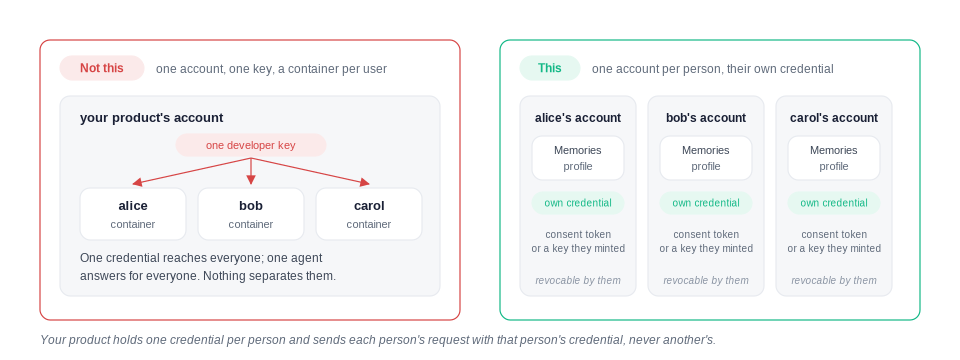
In Membase the person owns the memory, not the application. There is no application-wide key, no master credential and no per-user tag inside a shared store. Every credential belongs to one account, reaches only that account’s Memories, and was minted by that account’s owner.
If you have used a memory API where you tag content with a user id or container tag and one key reaches them all: that is not this. Here a Memory is one of the person’s own (a topic such as Project decisions), not a tenant, and no request names one.
The boundary
Section titled “The boundary”| Layer | How it is separated |
|---|---|
| Memory | every account has its own agent container, a small VM with its own volume. Its files, documents and learned memory live there and nowhere else. A search is a turn inside that container. |
| Control plane | accounts, credentials, bindings, billing and raw source bytes are rows keyed by the account, under forced row-level security in Postgres. A query cannot see another account’s rows even with the platform’s own connection. |
| Credentials | a developer key or a consent token carries its account. It cannot be widened from the calling side, only on the Connect page by the owner. |
| Model calls | a turn goes through the platform’s inference service under the account’s own model policy; a model credential never enters an agent container. |
| Deletion | revoking, narrowing or deleting takes effect on the next call, ahead of any cache, projection or issued credential. |
An id outside a credential’s reach reads the same as one that does not exist (404), so a
caller cannot even enumerate what it may not read.
A product that serves many people
Section titled “A product that serves many people”Give each person their own Membase account, and reach their memory with a credential that person minted or approved. Three shapes fit most products.
Your product is an MCP client
Section titled “Your product is an MCP client”If your product can act as an MCP client (an agent framework, a desktop app, anything that
speaks Streamable HTTP and OAuth), point it at https://api.app.membase.com/mcp-http. Each
user completes the consent screen once; your product holds one consent token per user and
gets the read tools (search_memories, the fact list, the media reads) and, when the user
ticked it, list_profile_facts. It cannot write and cannot see a Memory the user did not tick. The flow is in
Authentication & Scopes and the
client side in Any MCP client.
This is the shape to prefer: the user never handles a token, and can turn your product off on the Connect page.
Your product holds a key per user
Section titled “Your product holds a key per user”If your product needs to write (save what a conversation produced) or is not an MCP client, each user mints a developer key under Connect › Developer keys, chooses its level and reach, and pastes it into your product. Store it per user, encrypted at rest, and send it as that user’s bearer and nobody else’s.
from membase import Membase
def load_user_key(user_id: str) -> str:    ...  # your encrypted per-user store; returns the mbk_… token this user pasted
def memory_for(user) -> Membase:    return Membase(api_key=load_user_key(user.id))     # that user's key, never another's
memory_for(alice).search("what did we decide about the ledger")
Two rules follow. A key is refused with 403 the moment its owner revokes it or lowers its
level, so treat PermissionDeniedError as this user withdrew access, not as a bug; a
Memory the owner switches off for the key drops out of its searches and lists on the next
call. And never route
one user’s request through another user’s key: the platform cannot tell, but the memory it
answers from is the wrong person’s.
Your Memory answers people you sell it to
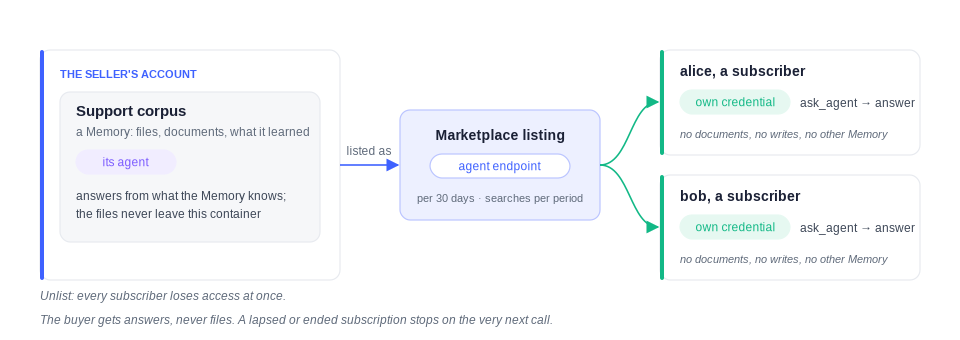
Section titled “Your Memory answers people you sell it to”The reverse case: you hold the memory (a support corpus, a product’s knowledge) and many
people ask it. List that Memory on the Marketplace; what is sold is the Memory, as answers.
Each subscriber receives a credential of their own that holds only ask_memory: the memory
engine answers from what the Memory learned, and the passages, documents and files never leave
your account. Lapsing a subscription stops access at once. See
Platform overview.
What is not isolation
Section titled “What is not isolation”- Memories are not users. Making one Memory per end user inside one account puts every user’s material behind one owner’s credentials and one agent. Nothing stops it, and nothing protects it either.
- Metadata is not a filter. Search has no metadata filters and
add_documentrefuses ametadatafield (422);custom_idis your own bookkeeping and cannot separate people. - Reach is not a secret. A key with All memories reaches Memories the user makes later. Say so when you ask for one.
Checking it
Section titled “Checking it”The negative cases are the ones to test:
| Try | Expect |
|---|---|
a doc_… or mem_… id from another account, with your key |
404 · not_found |
| a Memory the owner switched off for the key | on the very next call, searches and lists leave it out and its ids answer 404 |
| a revoked key | 403 · unauthorized on every call, at once |
delete_document on a Read & write key |
403 · unauthorized · not in this agent's capability profile |
delete_document on a Full access key without confirm |
428 · confirmation_required; nothing changed |
add_memory on a key that reaches several text Memories |
422 · write_target_required; nothing written |