Memory operations
Every verb of the agent protocol end to end: Memories, search, facts, profile facts, documents, media, ask, forget and delete, what a run does to them, and what code sees when the app does something.
The API has a handful of nouns and verbs. This page walks them in the order a program meets them, says what each does inside the user’s account, and what code sees when the person, a schedule or the app does something on its side. Every snippet is the Python SDK; the TypeScript and REST shapes are on the SDKs and the API reference.
| Noun | In the app | What it is | Id |
|---|---|---|---|
| Memory | a Memory | one named space of memory, with the agent that keeps it and the material it reads; text or media. Named in answers (memory_name), never addressed in a request |
— |
| memory | an item on a Memory’s page | one fact a Memory learned | mem_… |
| profile fact | a line under Settings › Your profile | one standing statement about the person (name, role, a lasting preference); the account’s, not a Memory’s | pf_… |
| document | a row under a Memory’s sources | one piece of raw material a Memory read: a file or page (kind: file), or a fact as it was said (kind: note) |
doc_… |
| media | a photo or video in a media Memory | one photo or video, with its moments | med_… |
Ids are typed and opaque. An id outside the key’s reach, an id of the wrong type and a string
that is not one of ours all answer 404. Every list is {items, has_more, partial}: the newest
limit (1–1000, default 100), whether more were left out, and the Memories that could not
answer; there is no paging.
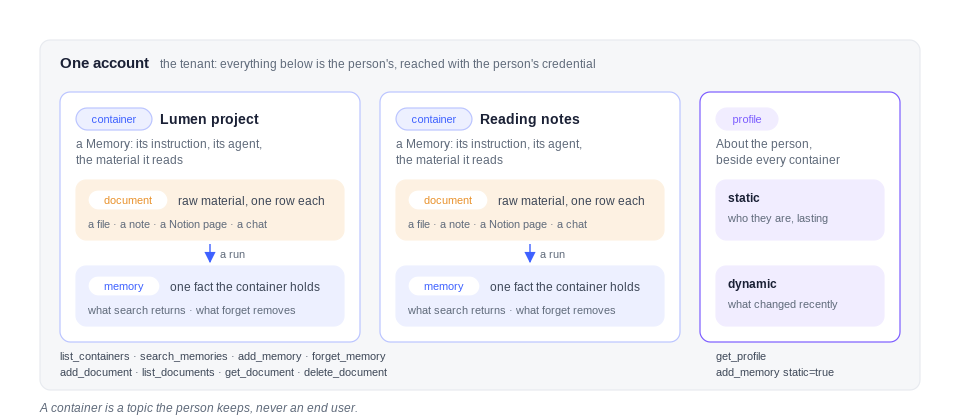
Memories
Section titled “Memories”caps = client.capabilities()caps["memories"] # [{"name": "Project decisions", "kind": "text"}, …]: what the key reachescaps["actions"] # ["search", "memories.list", "memories.add", …]: what it may doNo request names a Memory. Reads (search, lists, ids) cover every Memory the key reaches;
writes land in the key’s write target, the one text Memory it reaches. A key that reaches
several text Memories is refused on a write with 422 write_target_required
(WriteTargetRequiredError) and nothing is written somewhere by guess. Sending a container
is a 422 too: the API refuses fields it does not know. capabilities() names the Memories in
reach by name and kind, never by id; it is not permission, and every call is still checked when
made. A Memory outside the reach cannot be told apart from one that does not exist. The
assistant’s own memory is not a Memory here: code meets what it knows about the person as
profile facts.
What a Memory’s tile says in the app, and what it means to code:
| Tile word | Meaning | In the API |
|---|---|---|
| Add a source | reads nothing yet | in reach, list_documents lists nothing from it |
| On sale | listed on the Marketplace | buyers hold credentials that ask_memory it, and nothing else |
| Subscribed | bought from someone else | ask_memory only; no passages, no documents, no writes |
| no word | yours, reading at least one source | in reach; searches answer from what its runs learned |
Renaming a Memory changes the memory_name answers carry; ids never change. Deleting a
Memory is the owner’s, in the app, and has no agent-protocol verb.
Search
Section titled “Search”hits = client.search("what did we decide about the ledger", limit=5)for h in hits["items"]: print(h["memory_name"], "·", h["content"])A search covers every Memory in reach at once, and each passage names its Memory
(memory_name). Passages come most relevant first: type: "memory" is a learned fact and
carries its mem_ id (read it again with memories.get(id)), type: "document" is a passage
from a document. limit is how many in all (1–50), not per Memory. partial names each Memory
that could not answer (reason: "error") or whose passages all lost to limit
(reason: "truncated"); the others still answered. mode="fast" is one round of retrieval
with no model call, for recall before every turn of an agent whose own model judges what it is
handed; the default full is the engine’s whole retrieval.
A search is a turn inside the account’s container, not a query on an index. The first one
after a quiet spell includes runtime startup; the SDKs default to 90
seconds per request, which is configurable and is not a latency guarantee. There are no metadata filters, because there is no server-side index to apply
them to: put what matters in the content. Search is retrieval; ask is an answer.
A Memory with no learned content may return no results. Check partial before interpreting
an empty result: an unavailable model is a failed search, not evidence that no matching memory
exists. Search is not held to the two-turns-at-once limit, but like every call it can answer
429 when the token exceeds its per-minute request limit.
facts = client.memories.list(limit=20) # the newest facts, newest by when they happenedfor f in facts["items"]: print(f["id"], f["memory_name"], f["content"], f["source_time"])client.memories.get("mem_…") # one fact, at any agememories.list shows the facts the Memories in reach learned, newest by when they happened,
each with its mem_ id, memory_name, source_time (when it happened) and recorded_at.
memories.get reads one, however old: a search can name one older than any list shows.
Listing facts stands on the search grant, so any key that may search may list.
Profile facts
Section titled “Profile facts”facts = client.profile_facts.list(limit=50)for f in facts["items"]: print(f["id"], f["source_kind"], f["content"]) # "pf_…", "user_stated", "Prefers dark mode."
kept = client.profile_facts.add("Works in Lisbon, UTC+0.")kept["id"], kept["created"] # "pf_…", True; the same statement again: False
client.profile_facts.forget("pf_…", confirm=True) # {"id": "pf_…", "status": "forgotten"}The profile sits beside the Memories: a list of standing statements about the person, newest
first. Each has its pf_ id, content, recorded_at and source_kind, which says where it
came from: user_stated (the owner or one of their keys said it), imported, or
model_generated (the assistant recorded it in a conversation). The service sets
source_kind; a request cannot.
profile_facts.list needs the profile tick on the key. With the tick, what else the key may do
follows its level: a Read & write key may add a statement, a Full access key may also
forget one, with the same confirmation rule as forgetting a memory (428 without
confirm=true). Without the tick no profile operation is offered at all. Adding a statement
that is already there keeps the one there (created: false). There is no editing: a correction
is a new statement and the old one forgotten. List the profile once, near the start of a
conversation.
Add a memory
Section titled “Add a memory”receipt = client.memories.add("We settled on Postgres for the ledger.")receipt # {"id": "doc_…", "kind": "note", "status": "processing", "learning": [{"memory_name": "Project decisions", "status": "processing"}]}One fact, into the key’s write target. It is written as a note the Memory reads, and this call
starts its learning run asynchronously: it answers 202 with the note’s receipt, a document of
kind note. Poll documents.get(receipt["id"]) as for a document write; acceptance is not
completion. To remove the note, pass its doc_ id to delete_document; forget_memory takes
the mem_ id of a fact the Memory learned. Needs a Read & write key.
Add a document
Section titled “Add a document”doc = client.add("…the text…", title="Call with Acme", custom_id="call-2026-09-24")doc["status"] # "pending" or "processing"doc["id"] # "doc_…": poll documents.get(id)["learning"]The text (or a public url to fetch, one or the other) lands in the write target’s upload folder
in the account’s Files, is connected as a source on the spot, and a learning run starts on its
own; the call answers 202 with the receipt {id, kind: "file", status, learning}. The same
custom_id again names the document already there and starts nothing, so retries are safe.
id can be null on the 202 when the folder sync had not written the row yet; list the
documents a moment later. Uploads are capped at 32 MiB per file, on every plan.
What the 202 becomes
Section titled “What the 202 becomes”When a learning run starts, it appears on the account’s Activity page. learning on the
receipt and on documents.get(id) names each Memory with its status: pending (waiting for
the next run; the one in flight starts it when it ends), processing (a run is reading it now),
succeeded or failed. After a successful run over that material, search can retrieve what it
learned. A 202 alone does not guarantee that a run started: it can be deferred while the
agent is paused or capacity is unavailable. If it ends failed, the document is still listed
and still unread, and the Memory’s Report says why; usually the account has no working model
under AI Setup, or a source needs reauthorization.
Documents
Section titled “Documents”docs = client.documents.list(kind="file")["items"] # newest first; kind is "file" or "note"for d in docs: detail = client.documents.get(d["id"]) print(d["id"], d["memory_name"], d["title"], [e["status"] for e in detail.get("learning") or []])
client.documents.delete("doc_…", confirm=True) # Full accessA document is one piece of raw material a Memory has read or will read: a file in a folder
source, an uploaded file, a Notion page, a conversation the browser extension captured, or
what add_document handed in, or the note add_memory wrote. Its learning reads
succeeded once a run has committed it; it is the field to poll after a write. It is computed
per source, not per document: succeeded when the Memory’s last successful run is at or after
the source’s current version, under the Memory’s current instruction. So when a new file
lands in the same upload folder, every document in that folder reads pending again until
the next run, and changing the Memory’s instruction makes every document in it read pending
until it has run again.
Sync and run are two different things
Section titled “Sync and run are two different things”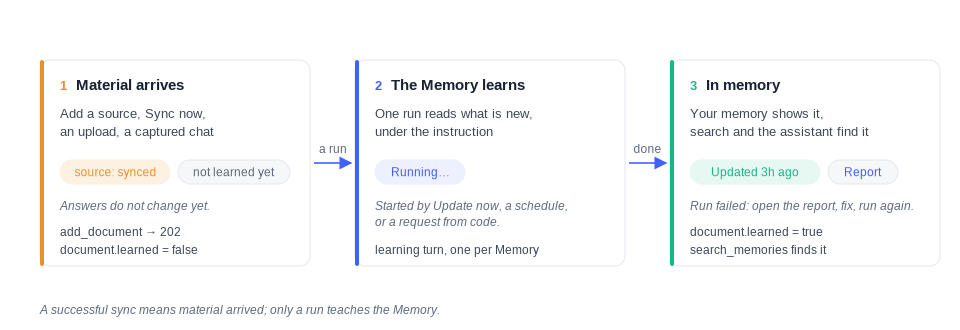
A sync fetches raw material and stops. It runs no model, reads nothing into memory and
never changes what a search answers. A run (the learning turn) is what reads the unread
material. In the app the Memory’s button says Update now while a source holds material
it has not read; a schedule does the same on a cadence; add_document starts a run itself.
“Unread” is decided by versions, not clocks: a sync that changed nothing, or a run on another
Memory, cannot make this one look up to date.
add_document normally starts learning without a schedule; if it is deferred, use the
Memory’s next run after fixing the cause. A schedule
matters for material that arrives without a call: a folder the person keeps adding to, a
Notion selection that changes. When a schedule fires, nothing changes in the API except the
memory itself: learning turns succeeded and the next search answers from what the run
learned.
There is no agent-protocol verb to create or pause a schedule; it is the owner’s, in the app.
client.media.list(limit=20) # photos and videos, newest first, each with a one-sentence summaryhits = client.media.search("someone skiing", kind="video")for m in hits["items"]: print(m["memory_name"], m["filename"], [(x["t"], x["text"]) for x in m["moments"]])client.media.get("med_…") # one item with all its momentsclient.media.delete("med_…", confirm=True) # Full accessA media Memory holds photos and videos, apart from documents and facts: search and the fact
and document lists do not read them. Each item has a summary, a file_url and a thumb_url
(routes on the API, read with the same bearer; a Range header answers 206 with that part).
media.get and media.search add its moments: a video’s shots and spoken lines, each with
t/end in seconds, speaker and thumb_url. Adding media over the API is not offered yet;
it arrives through the Memory’s sources in the app.
out = client.ask("Summarise what the seller learned about Postgres RLS.")out["answer"] # one answer, written from the Memories in reachout["citations"] # [{"memory_name": "Postgres notes"}]: the Memory, never the passagesout["partial"] # the Memories that could not answerask is the other kind of read next to search: the memory engine reads the Memories in reach
and writes one answer, with no agent, no tools and no session. citations name the Memory the
answer came from, never a passage. A model field is refused (422), like any field the API
does not know.
ask_memory is held only when a credential’s tool list names it, and today only a marketplace
buyer’s credential does: it reaches the one Memory bought, holds nothing else, and every call
takes one call of the period’s allowance. A developer key does not hold it at any level, and
the call is refused with 403 · unauthorized. A product that wants to put a model over the
person’s memory uses search and its own model (Claude API,
OpenAI API).
Forget and delete
Section titled “Forget and delete”from membase import ConfirmationRequiredError
try: client.memories.forget("mem_…")except ConfirmationRequiredError as e: print(e.details) # {"id": "mem_…", "verb": "forget_memory", "content": "…", "how": "…"}
client.memories.forget("mem_…", confirm=True) # {"id": "mem_…", "status": "forgotten"}client.documents.delete("doc_…", confirm=True) # {"id": "doc_…", "status": "deleted"}forget_memory takes the mem_ id of a learned fact, from memories.list, memories.get or
a search hit of type: "memory". A note added with add_memory is a document; remove it with
delete_document.
Both need a Full access key (as do media.delete and profile_facts.forget, the latter with
the profile tick), and even then they do not run on a bare call: without
confirm=true nothing changes and the answer is 428 confirmation_required
(ConfirmationRequiredError), naming the target by its public id and carrying a how
sentence to relay to the person. Pass confirm=true only after they agreed; from a developer
key that counts as the owner’s confirmation. Forgetting a fact leaves the material it was
learned from; deleting a document withdraws it and what every Memory learned from it (the file
goes to the Files trash). A consent-minted client is never offered these verbs at
all: its token is read-only, so from an AI app the call is refused with 403 · unauthorized · token missing required scope, not answered with the sentence. What is
forgotten or deleted is gone from the next search; nothing on the platform caches it.
Deleting a Memory, a source’s imported material or the account has no agent-protocol verb; those are the owner’s, in the app.
client.capabilities()["rules"]GET /v1/capabilities carries the standing rules for this credential under rules
(citation_required, retention_notice, version): what the skill tells an AI about behaving
beneath the ceiling the server enforces. Over MCP the same answer is get_capabilities; there
is no separate rules call.
What code sees when the app does something
Section titled “What code sees when the app does something”| The person | Code sees |
|---|---|
| selects Update now, or a schedule fires | documents’ learning turns succeeded; the next search answers from the run |
| switches a Memory off for the key under Use in | on the very next call, same token, searches and lists leave it out and its ids answer 404; if the key is left with one text Memory, that one becomes its write target |
| lowers the key’s access | 403 · not in this agent's capability profile on the verbs above it |
| revokes the key, or it expires | 403 · unauthorized on every call; mint another |
| removes a source | its documents stop being listed; what was learned stays until the Memory is deleted |
| deletes the Memory | its memory_name no longer appears; searches no longer answer from it |
| has no working model for its agent | a failed turn, surfaced as 422 · capability_unavailable or a search entry in partial (reason: "error"); stored memory remains, documents may wait unread. Read code on a 422: validation there is a request the API cannot take, and write_target_required a write with nowhere to land, not a model problem |
| is on the free plan with its free turns spent | 422 · capability_unavailable with details.reason: "dormant" until they bring a model or move to a paid plan |
| already has two agent turns running, or a token exceeds its per-minute request limit | 429 · rate_limited. The turn limit hits agent turns (search is not held to it; add_document never is, its learning waits as pending); the per-minute limit hits any call, search and add_document included. No Retry-After is sent; the SDK backs off and retries twice |
Rules of the road
Section titled “Rules of the road”- Profile once, search per question. The profile facts are few and standing; search is a turn inside the user’s memory.
- Cite the Memory. Every hit names its Memory (
memory_name); say where an answer came from. - Save what the user supplied, in their words, and only when they asked or plainly meant to.
- Never confirm on your own. A delete or forget without
confirm=truechanges nothing and answers428with ahowsentence; relay it and stop. - Treat
403as withdrawn access. The owner narrowed or revoked the key; do not retry with it. - Allow for cold starts. Configure a suitable timeout and inspect
partial; see API troubleshooting. - Do not store to filter later. There are no server-side metadata filters; use
custom_idfor your own bookkeeping. - The token stays out of logs. Log the key’s hint (
mbk_7f3a92d1…), never the token.